Elizabeth March
Little WomenElizabeth March, almost always called Beth, is the March family's gentle center and its most powerful example of unassuming goodness. The thirteen-year-old is shy, domestic, musical, and intensely compassionate; she rarely seeks attention, yet her care for dolls, family, neighbors, and household duties gives her a moral importance far greater than her quiet manner suggests. Her illness and eventual death turn that hidden influence into the emotional test through which the March family understands love, duty, grief, and the limits of worldly ambition.
Identity and Domestic World
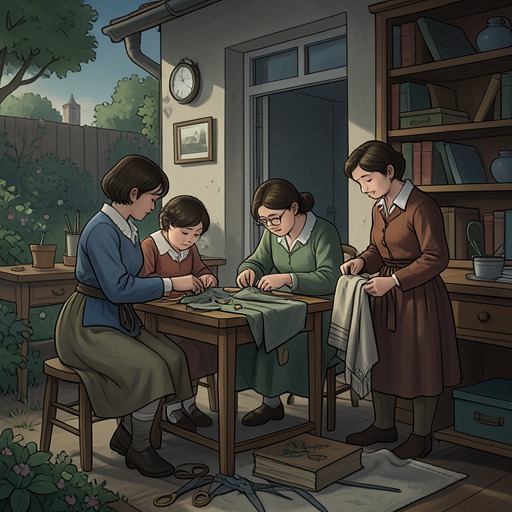
Elizabeth March is the third of the four March sisters, younger than Margaret March and Josephine March and older than Amy Curtis March. Margaret March calls her “a dear, and nothing else,” and the family accepts the judgment because Beth is its pet, the beloved “Mouse” whose sweetness does not need qualification. Unlike her sisters, she is not defined by social ambition, artistic fame, or a desire for refinement. Her presence is associated with the quiet interior life of the March family home, where work, music, affection, and imagination make a plain household spiritually abundant despite poverty and the absence of Mr. March during the war.
Beth is too bashful for school. The attempt to educate her there causes such distress that it is abandoned, and she continues her lessons at home, first with her father and later on her own after he leaves. When Mrs. March is called away to work for Soldiers' Aid Societies, Beth remains faithful to her studies and helps Hannah Mullet keep the house neat and comfortable for the workers. She expects no reward beyond being loved. Her education is therefore inseparable from self-discipline and service: she learns within the household while helping preserve that household for others.
Her domesticity is active rather than passive. Beth fills long days with useful tasks and imaginary companions, behaving like a “busy bee” even when she is alone. Six dolls must be dressed each morning, and she turns the rejects passed down by her sisters into patients in a hospital for infirm dolls. She feeds, clothes, nurses, and caresses them, refusing to punish or neglect even the ugliest and most damaged. One ruined doll rescued from Josephine March's rag bag receives a cap, a blanket, a bed, fresh air, songs, and a nightly kiss. Beth's tenderness is most revealing when directed toward what others have discarded: compassion is not a decoration in her character but her habitual way of organizing the world.
Music and the Laurence Family
Music provides Beth with a form of expression that her shyness otherwise denies her. Her family knows that she longs to play the piano at the Laurence mansion, but she is initially too timid to enter openly. After James Laurence gives her the piano, she first responds with astonished gratitude and then ventures into the drawing room, where she touches the instrument with trembling fingers. Once the music begins, fear and self-consciousness fall away; she forgets herself in the pleasure of playing, experiencing the instrument as the voice of a beloved friend.
The gift creates an intimate bond between Beth and James Laurence. She visits the mansion almost daily through the hedge, slipping into the drawing room like an unseen musical spirit. She does not know that James Laurence opens his study door to listen, that Theodore Laurence guards the hall so the servants will not disturb her, or that the exercise books and new songs placed in the rack are intended for her. Her gratitude is answered by a quiet generosity that asks for no public acknowledgment. The piano thus crosses the boundary between the March family home and the Laurence mansion, turning neighboring wealth into a resource shared through affection rather than social display.
Beth's music also becomes a measure of her place within the larger community. When she falls ill, James Laurence locks the grand piano because he cannot bear the reminder of the young neighbor who once made twilight pleasant for him. Her absence is heard as silence. The gesture shows that Beth's influence has never depended on conversation or social prominence: her repeated, almost invisible visits have altered the emotional atmosphere of the Laurence household.
Courage in Care and the Scarlet Fever Crisis
Beth's gentleness does not mean that she is sheltered from suffering. During her mother's absence, she visits Mrs. Hummel, whose baby is desperately ill. When Elizabeth March learns that the child has died, she explains that she held it in her lap until Mrs. Hummel returned with the doctor. The doctor identifies scarlet fever in the household, noting that Heinrich and Minna also have sore throats and that medical help was sought too late because Mrs. Hummel was poor and had tried to treat the baby herself. Beth listens, cries with the family, and still returns home, taking belladonna after recognizing symptoms in herself.
Her action is both compassionate and dangerous. She does not dramatize the risk, but she has placed herself in direct contact with a contagious disease while caring for a poorer family. The episode reveals how Beth's domestic virtue extends beyond the March household: care is a responsibility she performs instinctively, even when the social and medical consequences are serious. It also exposes the unequal conditions surrounding illness, since poverty delays Mrs. Hummel's access to a doctor and turns nursing into an improvised burden.
Beth does contract scarlet fever, and her condition is much worse than the girls realize. Hannah Mullet and the doctor conceal the severity from the family, while Margaret March remains at home and Josephine March stays constantly beside the sickbed. The illness reorganizes the entire household. Amy Curtis March, sent away for safety, longs to return and work for Beth, recognizing with remorse how many tasks her sister's willing hands had previously performed. Neighbors and tradespeople ask after her, Mrs. Hummel comes to seek forgiveness and obtain a shroud for Minna, and the family's surroundings reveal how many friends Beth has quietly made.
Even while delirious, Beth remains attached to her obligations and affections. She worries about Josephine March, sends loving messages to Amy, asks that her mother be told she will write soon, and tries to reassure Mr. March that she has not neglected him. Her thoughts show that family duty is not imposed on her from outside; it has become the language through which she understands herself. The same girl who nurses broken dolls and comforts a poor household continues, even in fever, to imagine herself responsible for others.
Decline, Revelation, and Death
The crisis becomes unmistakable on the first day of December. Dr. Bangs examines Beth, holds her burning hand, and tells Hannah that Mrs. March should be sent for if she can leave her husband. Josephine March sends the telegram, having already endured the strain of being separated from both parents. When Laurie asks whether Beth is worse, Jo confesses that Beth no longer knows them or speaks coherently about the “flocks of green doves” she once used to name the vine leaves on the wall. Her despair comes not only from the disease but from the collapse of the familiar world: her mother and father are absent, and even God seems distant.
The family's fear is answered by human solidarity. Laurie takes Josephine March's hand and promises that he is there, and the physical grasp gives her enough comfort to endure the immediate darkness. Beth's illness therefore reveals the reciprocal nature of the bonds she has spent her life creating. She has been the one who comforts, nurses, and quietly sustains; now her suffering summons the care of sisters, neighbors, servants, and friends, making visible the network that her unobtrusive goodness has built.
Beth survives the immediate scarlet fever crisis, but she does not regain her former strength. When Josephine March returns in the spring, absence has sharpened her perception: Beth's face is only slightly paler and thinner, yet it has acquired a transparent quality that makes her seem to be slowly fading from the mortal world. Beth appears happy, so the family can pretend that improvement is continuing, but Jo's anxiety returns whenever the household grows quiet. Beth refuses a distant mountain trip and prefers a nearby seashore, where open air and sea breezes may restore color to her cheeks. There, she and Jo remain almost entirely devoted to one another, as if both sense that their long separation is approaching.
Beth eventually tells Josephine March that she knows she is dying. She does not meet death with theatrical visions or grand declarations; instead, she accepts it as the next stage of a life already shaped by trust, family, and faith. She asks Jo to take her place, to become everything Mr. March and Mrs. March will need, and to remember that love matters more than writing splendid books or seeing the world. Josephine March renounces her former ambition in response, pledging herself to a new purpose founded on service and affection.
Beth dies in spring, while Mr. March and Mrs. March guide her tenderly through the Valley of the Shadow. The end comes quietly, in the dark hour before dawn, on the breast where she first drew breath. There is no elaborate farewell: only one loving look and a little sigh. Her family's tears and prayers accompany the preparation of her body, while the serenity that replaces her long patience allows them to understand death not as a dreadful phantom but as a merciful release from pain.
Character and Narrative Significance
Elizabeth March's significance lies in the contrast between her small social presence and her immense emotional reach. She is not a public leader, a celebrated artist, or an ambitious reformer. Her influence accumulates through repeated acts that might seem minor in isolation: studying alone, keeping the house comfortable, caring for rejected dolls, playing old-fashioned airs, nursing a dying baby, worrying about family correspondence, and accepting music as a gift with unguarded gratitude. The novel makes these acts consequential by showing how deeply their absence is felt.
Beth also embodies the book's distinction between talent and character. Her music brings joy to James Laurence and Theodore Laurence, but her deepest power comes from the patience and tenderness with which she treats vulnerable beings. Her illness makes the family recognize the labor she had performed without complaint; her death makes Josephine March revise the hierarchy of her dreams. In that sense, Beth does not merely disappear from the story. She continues to govern the choices of those who survive her.
Her arc joins the Civil War home front to the intimate history of the March family. While Mr. March serves as a chaplain and Mrs. March works with Soldiers' Aid Societies, Beth sustains the domestic base from which their service is possible. Mrs. March teaches the sisters to “Hope and keep busy,” and Beth has already made that principle a way of life. Her final lesson is that love outlasts achievement: it can be carried beyond separation, illness, and death, and it converts an ordinary household into a lasting moral community.